
What’s New in Frameliq: Claude and ChatGPT, Seedance 2.5, Locked Sets and More
Everything that shipped in Frameliq in September 2026: write a film from Claude or ChatGPT, Seedance 2.5 and GPT Image 2.5, locked sets, lip sync, voice masters and Composer upgrades.
September was the busiest month of releases Frameliq has had. This post collects all of it in one place, in the order you meet each feature when making a film: writing, cast and places, storyboard, then Composer.
1. Write your film from Claude or ChatGPT
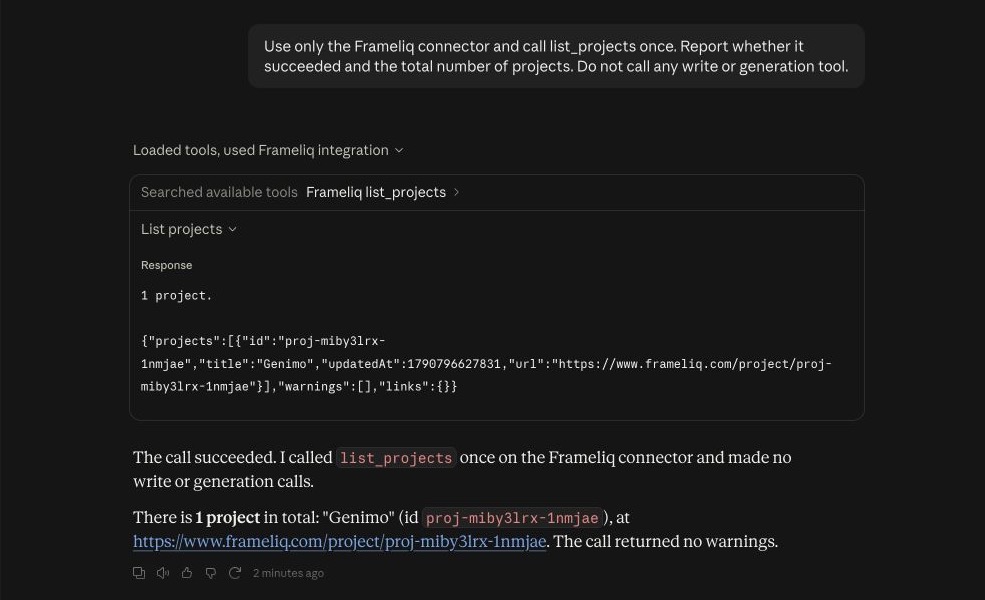
Frameliq now connects to Claude and ChatGPT. You describe a film in a chat, and the assistant writes each stage straight into a Frameliq project: the idea and logline, characters and places, beats, the screenplay, a storyboard plan with a frame prompt for every panel, and a motion prompt for every Composer shot.
The assistant can also work on a film you already started. It can review the whole project and list what is weak, fix a character whose look drifts between scenes, or rewrite every shot prompt for a different video model in one pass.
- The writing runs on your Claude or ChatGPT subscription, so it uses none of your Story credits.
- Every change gets a change id. Ask the assistant to undo one within 30 days and it restores exactly what it changed.
- Text you edited in the app after the assistant last read the project is never overwritten.
- If the project is open in Frameliq, the page updates as the assistant’s edits arrive.
- Images, video and voices are still generated inside Frameliq. The assistant writes text and prompts only.
The connection is included in every paid plan. Setup takes about two minutes and the steps for both assistants are on the integrations page. We also wrote two longer guides: making a film from ChatGPT and making a film from Claude.
2. Seedance 2.5 in Composer
Seedance 2.5 is a new model family in Composer, next to Seedance 2.0. It generates takes from 4 to 30 seconds at 480p, 720p or 1080p, with sound, in four modes: text to video, image to video, first and last frame, and reference to video. Reference mode accepts up to 9 images, 3 videos and 3 audio clips, 12 in total.
Two things to know before you use it. Its content filter rejects photoreal faces, so it suits stylised characters better than live-action lookalikes, and Composer now explains that when a take is rejected. A reference that is a video needs your own fal key for now. Our Seedance guide covers prompting and when to pick it over other models.
3. GPT Image 2.5 Flare and Sunburst
GPT Image 2.5 arrived in two variants. Flare is the default and the faster of the two. Sunburst adds more detail. Both are available in the Storyboard and Writer image pickers, character portraits, Cast & places looks and angles, and the image editor. GPT Image 2 is still there if you prefer it.
AI Paint also got clearer. Its Identity engine is the one that repaints a masked area with a specific character’s face, and it now runs on GPT Image 2.5 Flare by default. The two FLUX engines are for general inpainting and cannot use a character reference. The editor tells you so if you select a character.
4. Locked sets and a chosen continuity frame
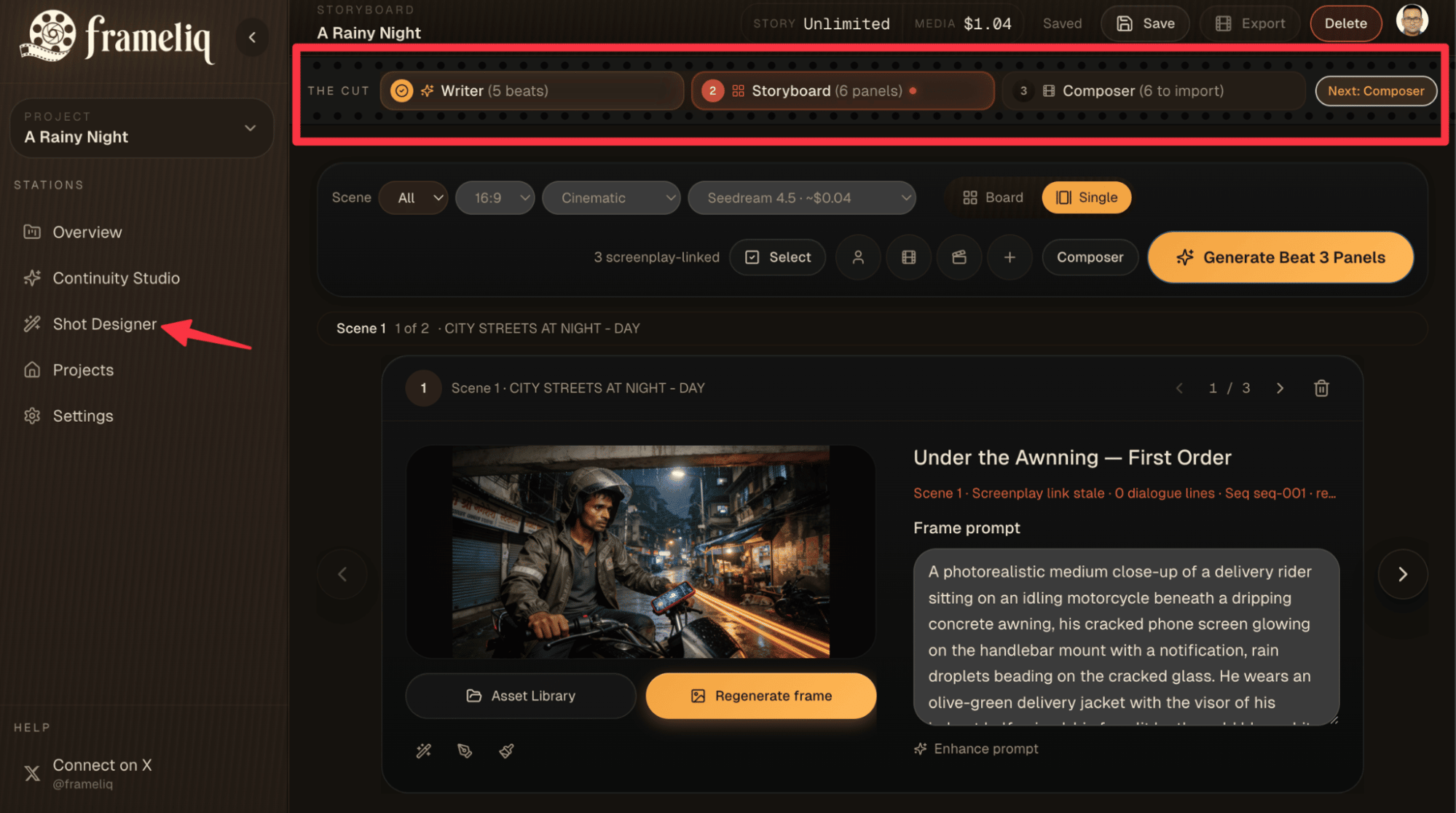
A place can now be marked as a locked set with a short note on what stays where. Storyboard stills for that place keep the layout, furniture and props in position, and only the people, their poses and the camera change. It works with GPT Image 2, Nano Banana and Seedream.
“Start from the previous frame” can now continue from a frame you choose instead of the nearest earlier one. One good frame can anchor a whole run of shots.
5. Upload your own reference angles
Characters and places in Cast & places accept your own photos as reference angles, next to or instead of generated ones. Each upload gets the next unused view, such as three-quarter, side or back, and you can relabel any angle from its thumbnail.
6. Lip sync and voice masters
Lip sync is a Composer mode on H3 Max. It takes one still and the scene’s recorded dialogue and animates the face to the audio. The clip length follows the audio, between 5 and 14.8 seconds.
A voice master gives a character one voice for the whole film. Set up the voice on the character’s Writer card, then create a master or supply a sample you have permission to use. Composer attaches the right voice to each dialogue shot.
7. Composer upgrades
- Extend (H3 Max) continues the take of the shot right before it, so the two clips play back to back. It runs on your own fal key.
- One shot per frame is a toggle in the storyboard import picker. Turn it on and every frame becomes its own shot instead of merging into sequences.
- Clear timeline removes every shot and audio lane in one step, so a rebuilt storyboard imports fresh. Rendered files stay in the Asset Library.
- Switching the model on a shot now snaps the duration to the nearest length the new model allows.
8. More included generation on Studio plans
Studio now includes 2,500 Media credits a month and Studio Pro includes 5,000. The Media credit top-up pack went up to 1,500 credits.
Try it
All of this is live. Open a project to use the new models, or connect your assistant from the integrations page and ask it for a film. New to Frameliq? Create an account and follow the step-by-step short film tutorial.